
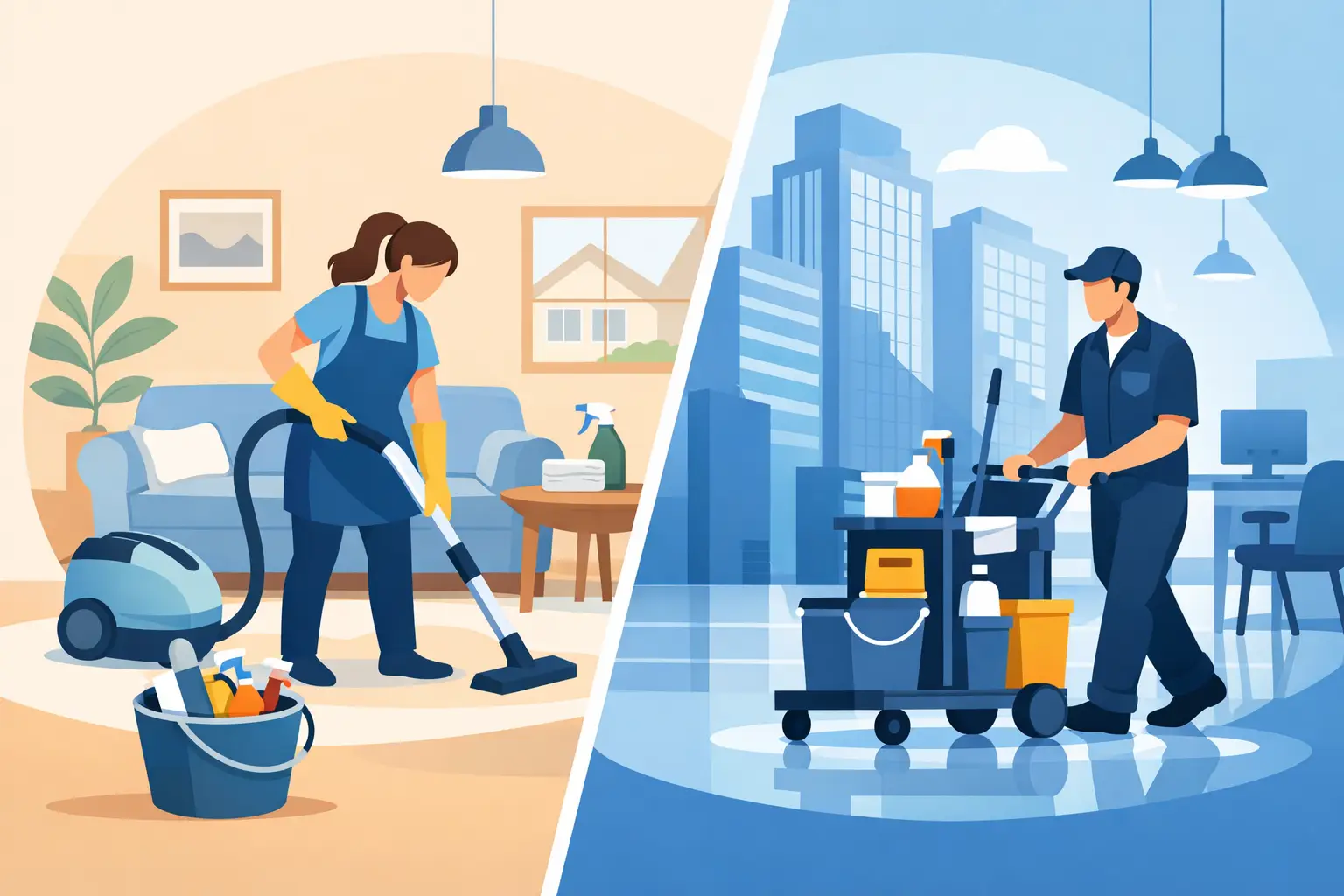
A kitchen that needs its stovetop degreased and a medical office that needs its waiting room sanitized are both “cleaning” jobs. That is where the similarity ends. Residential cleaning versus commercial cleaning involves different spaces, priorities, schedules, equipment, and expectations. Choosing the wrong type of service can leave important work out of scope, create confusion about pricing, or set the wrong standard from day one.
For New Jersey households and business owners, the right choice comes down to how the space is used, who occupies it, and what must happen consistently between visits.
Residential Cleaning Versus Commercial Cleaning: The Core Difference
Residential cleaning is designed around the way people live at home. The work is personal, detailed, and centered on rooms such as kitchens, bathrooms, bedrooms, living areas, and entryways. A professional team is cleaning around your routines, furniture, appliances, personal belongings, pets, and family needs.
Commercial cleaning is designed around how an organization operates. Offices, retail spaces, clinics, common areas, break rooms, and restrooms need to stay presentable, hygienic, and ready for employees, customers, tenants, or visitors. The work is typically more repeatable across a larger or more standardized environment.
Neither service is automatically more difficult. They demand different systems. A home can require intensive detail work in tight, highly personal spaces. A commercial property may require strict timing, access procedures, higher-traffic maintenance, and a defined scope that covers dozens of desks, multiple restrooms, or shared areas.
Residential Cleaning Is Built Around the Home
A home cleaning service should make daily life easier, not create another task for the homeowner. That means the crew needs a clear process for cleaning high-use surfaces, handling room-by-room priorities, and respecting the fact that this is your private space.
The first visit usually requires more work
For most recurring residential clients, a standard maintenance clean is not the best place to start. Dust, soap buildup, grease, crumbs, and neglected areas accumulate differently in every home. If a cleaning team begins with a light maintenance service, it may spend every future visit trying to catch up.
That is why Best Maids Ever begins recurring residential service with a 1st Time Deep Clean. The goal is simple: reset the home to a clean baseline, including the inside of appliances, before moving into a weekly, bi-weekly, or monthly maintenance schedule. Once the baseline is established, ongoing cleaning is more consistent and more predictable.
A deep clean generally focuses on the details that do not receive attention during a typical weekly tidy-up. This can include buildup in bathrooms, kitchen grease, baseboards, doors, reachable light fixtures, and interior appliance cleaning. The exact scope should always be confirmed before service, especially in homes that have not been professionally cleaned recently.
Residential work requires personal trust
A commercial crew may clean after the office is closed. Residential cleaners often work while a homeowner is present, around children or pets, and near personal items. That raises the standard for professionalism.
Homeowners should expect insured cleaners, criminal background checks, clear arrival windows, and an established satisfaction policy. A low price is not a substitute for accountability. When someone is working inside your home on a recurring basis, you need to know who is arriving, what they are doing, and what happens if a detail is missed.
Frequency depends on household activity
A one-bedroom apartment with one occupant may stay in good condition with monthly service. A home with children, pets, a busy kitchen, and two working adults often benefits from bi-weekly or weekly cleaning. There is no universal schedule because homes do not create the same mess at the same pace.
The practical question is not, “How often should a house be cleaned?” Ask instead: “How long does my home stay at a level I am comfortable with after it is professionally cleaned?” That answer usually points to the right schedule.
Commercial Cleaning Is Built Around Operations
Commercial cleaning has a different job. It must support the business without disrupting the business. A cleaning plan for an office, retail store, or professional facility should be based on traffic patterns, business hours, building access, staffing needs, and the specific areas that affect employees and visitors.
Consistency matters more than a one-time reset
A commercial property still benefits from an initial detailed clean, particularly after construction, a move, or a lapse in service. But the ongoing plan is usually the priority. Businesses need floors, restrooms, common areas, trash removal, touchpoints, and break rooms maintained on a reliable schedule.
For example, a small office with ten employees may need cleaning two or three evenings per week. A customer-facing business may need daily attention to restrooms, glass doors, and entry floors. A shared building common area can need service based on the number of tenants and visitor traffic.
The service plan should be specific. “General cleaning” is too vague for a business that needs accountability. A solid commercial scope defines which rooms are serviced, what happens at each visit, when consumables are handled if included, and which tasks are periodic rather than routine.
Commercial cleaning often has more logistical requirements
Businesses may require key or alarm procedures, building access instructions, security rules, after-hours service, and coordination with property management. The cleaning team may also need to work around employees, inventory, clients, sensitive documents, or specialized equipment.
That does not mean commercial cleaning is automatically impersonal. It means the service must be operationally disciplined. A reliable provider confirms the scope, communicates changes, keeps the schedule, and has a clear process when an issue needs correction.
High traffic changes the cleaning priorities
At home, the kitchen and bathrooms often receive the most attention. In a commercial setting, restrooms, entryways, break rooms, floors, conference rooms, and high-touch surfaces may drive the entire schedule.
Cleaning and disinfecting are not identical services. Cleaning removes soil and buildup. Disinfecting uses an appropriate product and contact time to reduce germs on targeted surfaces. A business should discuss its actual needs instead of assuming every surface requires the same treatment at every visit.
Differences in Scope, Supplies, and Pricing
Residential and commercial cleaning both require trained staff and quality products, but the tools and planning can be very different. A residential team may bring supplies suited to kitchens, bathrooms, delicate finishes, and household surfaces. A commercial team may need larger floor-care equipment, higher-capacity vacuums, site-specific products, and procedures for more expansive spaces.
Pricing is also structured differently. Residential service is commonly priced by the home’s size, condition, number of bedrooms and bathrooms, and requested add-ons. A move-in or move-out clean, organization service, eco-friendly request, or carpet cleaning add-on can change the total because it changes the labor and time required.
Commercial pricing is usually based on square footage, facility type, traffic level, number of restrooms, service frequency, access conditions, and task list. An office that needs nightly trash removal and restroom care is not priced the same way as a small professional suite cleaned once a week.
Transparent pricing matters in both cases. The right provider explains what is included before the service begins. No one should be surprised by vague add-on charges after the job is complete.
How to Choose the Right Cleaning Service
Start by identifying the space, not just the word “cleaning.” If the work is for your apartment, house, condo, or rental property, you need a residential plan built around personal spaces and your preferred maintenance level. If the work supports employees, clients, customers, tenants, or visitors, you need a commercial plan with a clearly defined recurring scope.
There are a few situations where the line can feel less obvious. A home office inside your house is still primarily part of a residential service, unless it has staff, client traffic, or requirements beyond normal household cleaning. A short-term rental may need a residential-style turnover clean but with commercial-level scheduling discipline. A mixed-use property may require separate scopes for the residence and the business area.
Before booking, ask direct questions. What is included on the first visit? What is included on recurring visits? Are interior appliances, baseboards, carpet cleaning, or organization part of the scope or separate services? Is the staff insured and background checked? What happens if the service does not meet expectations?
Clear answers are a good sign. Cleaning should feel dependable, not uncertain. Choose the service designed for the way your space is actually used, then put it on a schedule that keeps the standard where you want it.